
The Possibilities of Avant-Garde Continuity
In Hungarian literary discourse, the possibility of continuity between the historical avant-garde and the neo-avant-garde has received less attention than in international neo-avant-garde studies. For instance, rupture is a frequently used notion to describe the history of Hungarian avant-garde literature. It suggests that the continuity of the avant-garde diminished as a result of the two world wars.1 Answering the question of continuity was further complicated by how state socialism treated the historical avant-garde. Due to the cultural policy of state socialism, art that was endorsed and had a regular presence in museums and exhibition spaces in Western Europe and the United States after World War II was obstructed and mostly remained hidden from the broader public in Hungary; for instance, a representative collection of neo-avant-garde art and theory published in 1981 did not dwell on Hungarian neo-avant-garde movements.2 At the same time, Hungarian avant-garde practices that emerged in the late 1960s and 1970s were not admitted by contemporaries as a continuation of the historical avant-garde, but rather as derivatives of international artistic movements, such as Fluxus, Pop Art, Op art, concrete poetry, and visual poetry. In the cultural atmosphere of state socialism, these tendencies were condemned as imported Western fashions that embarrassed and provoked socialist lifestyle and aesthetic norms; this perception contributed to the marginalisation of the movement and forced the Hungarian neo-avant-garde into the second public sphere.3
After the Hungarian regime change in 1989, rupture continued to function as a constitutive term in discussions of avant-garde continuity. By this time, the growing interest in neo-avant-garde literature was partially based on the recognition of the historical avant-garde, but to a greater extent on the canonisation of postmodern literature. Consequently, the neo-avant-garde was placed in a teleological narrative of literary history that considers it a precursor to postmodern literature.4 Nevertheless, in recent years, research on the continuity of Hungarian avant-garde has gained momentum. In alignment with international avant-garde studies, Dadaism has been identified as a link between the historical avant-garde and the neo-avant-garde through its subversive, incoherent, and capricious attitudes, which remain alive in neo-avant-garde practices.5 Recent studies on avant-garde continuity have focused on structural and poetic congeniality, emphasising parallels and similarities.6
Nevertheless, the avant-garde tradition could not be conceived merely as an abstract construct. The well-known debate between Peter Bürger and Hal Foster on the status and value of the neo-avant-garde offers an example of this in a particular way. From Bürger’s perspective, regarding the concept of the avant-garde as a realisation of modernity, the neo-avant-garde may indeed appear as a theoretical scandal.7 From this viewpoint, the neo-avant-garde represents an inauthentic repetition of the historical avant-garde that undermines its subversiveness. As Bürger argued, “Neo-avant-gardiste art is autonomous art in the full sense of the term, which means that it negates the avant-gardiste intention of returning art to the praxis of life”.8 Hal Foster challenged Bürger’s argument. He argued that it was precisely the neo-avant-garde that accomplished the project of the avant-garde, insofar as it critically reflected on the tension between the boundaries of everyday life, art, and institutionalisation.9 Thus, Foster reversed the relation between the two avant-gardes: he did not consider the neo-avant-garde to be an unsuccessful imitation, but, based on the Freudian–Lacanian notion of deferred action (Nachträglichkeit) he conceptualised it as a traumatic return capable of revising the internal contradictions that led to the failure of the historical avant-garde.
Although these positions aim to establish a widely applicable theoretical framework for the avant-garde and the neo-avant-garde, they also raise important questions about where the two authors derived their assessments from. Bürger’s critique of the neo-avant-garde was influenced by the representatives of the historical avant-garde, especially former Dadaists, whose publications from the 1960s and 1970s targeted the so-called Neo-Dada.10 On the other hand, Foster’s theory does not project expectations attributed to the historical avant-garde onto the neo-avant-garde; rather, he examines the succession of the former from the perspective of the latter. These theoretical standpoints were thus strongly shaped by how the avant-gardist and neo-avant-gardist actors understood their own historical position and their relation to each other. All this draws attention to a possible approach, which examines continuity not through abstract interpretative models of the avant-garde, but through the canonisation and self-canonisation strategies maintained by both the avant-garde and neo-avant-garde actors.
The relationship between the historical avant-garde and the neo-avant-garde in terms of poetical and habitual similarities is also a conscious labour on tradition. At the time of the emergence of the neo-avant-garde, artists of historical avant-garde, such as Lajos Kassák, despite the adverse circumstances of Hungarian state socialism, but due to their international recognition, possessed a symbolic authority and historical relevance that could not be ignored by those who proclaimed themselves artists of the neo-avant-garde. However, the transformation of the historical avant-garde into a tradition by the neo-avant-garde involves processes of sorting: neo-avant-garde artists selected particular elements of the historical avant-garde that seemed relevant to them, based on their own interests and the surrounding context. Nevertheless, the historical avant-garde artists were still alive at the time of the emergence of the neo-avant-garde, thus they experienced their oeuvre becoming tradition. Consequently, they had the opportunity to intervene in this process through their statements and reflections.
This paper discusses the example of Károly Tamkó Sirató, whose Dimensionist Manifesto was elaborated in the 1930s, and became a point of reference for certain circles of the neo-avant-garde in the 1970s. The peculiarity of this case is that while his earlier work became more valuable, Károly Tamkó Sirató did not consider dimensionism to be directly continuable during this period, instead, he proposed a different method to revive the tradition of the historical avant-garde.
Károly Tamkó Sirató and the Currentness of Dimensionism
Károly Tamkó Sirató is a distinguished figure of the Hungarian historical avant-garde, who is also relevant when speaking on the continuity with the neo-avant-garde. Especially his experiments in visual poetry have found resonance in the neo-avant-garde, as András Kappanyos argued, for example, the so-called neo-avant-garde anthology entitled Ver(s)ziók (1982) contains numerous works engaged with his oeuvre.11 Tamkó Sirató did not solely witness the emergence of the neo-avant-garde, but was also able to follow its most active period until his death in 1980. All this also means that, while he witnessed his own work becoming part of the tradition appropriated by the neo-avant-garde, he had the opportunity to accompany this process with substantive reflections, and to confront the emerging tradition with his own renewed late artistic aspirations of the 1970s.
The author is best known for his Dimensionist Manifesto, which he published in 1936 while living in Paris. This manifesto, unlike any previous avant-garde manifesto, does not proclaim a distinct aesthetic programme. Tamkó Sirató regarded it as summary of the theory of art development.12 According to his concept, the various art forms are continuously enriched by a new dimension; thus, development of art can be described by the formula N+1. According to this model, poetry steps out of the line and enters the plane; painting moves into the spatial dimension from the plane; sculpture conquers the fourth dimension; and at the end of the process there is the utopian Cosmic Art: “The human being, rather than regarding the art object from the exterior, becomes the centre and five-sensed subject of the artwork, which operates within a closed and completely controlled cosmic space.”13 At the time of its publication, the manifesto did not stand out for its originality. Its main observations and aims were already circulating within the avant-garde artistic thought of the period; nevertheless, it successfully synthesised aspirations that had previously run in parallel.14 The project’s later recognition grew through the fact that the signatures of the most prominent avant-garde artists of the time, including Arp, Duchamp, Picabia, Picasso, Kandinsky, Miró, and Moholy-Nagy, came to be attached to the manifesto.
Tamkó Sirató’s tragedy lies in the fact that before his initiative could develop into a movement under his leadership—indeed, only a few days after the manifesto was released—he was forced to move back to Hungary due to a serious illness. As a consequence of his decades-long medical treatment, the development of World War II, and later the rigorous cultural policy of state socialism, his previous French network ceased, and, with the exception of the 1937/2 special issue of the Parisian Plastique published despite Tamkó Sirató’s absence, dimensionism was interrupted. Although Tamkó Sirató produced only a limited number of works that can be considered dimensionist in the 1930s, his manifesto remained important to him in later years as well: he regarded it as his contribution to the international avant-garde movement, and on his postcards referred to himself as “the author of the Manifeste Dimensioniste.”15
However, in the 1960s and 1970s, he deemed dimensionism primarily as an object of historical significance rather than as a living artistic movement. Hence, in an interview he did in 1977, he explained why the influence of dimensionism is lacking in his later works: “Dimensionism does not concern me today [] I would only be interested if I could be in Paris again. However, at the age of sixty-eight, I have hardly any possibility of that.”16 Perhaps because of the concurrence of the avant-garde re-evaluation in the West and the anticipated but unrealised success of dimensionism in the 1930s, Tamkó Sirató was commissioned by the Hungarian General Publishing Directorate in 1959 to recollect the history of the Dimensionist Manifesto.17 The monograph titled A dimenzionizmus I. albuma [First Album of Dimensionism] was most likely completed by 1966, but remained unpublished during Tamkó Sirató’s lifetime, appearing only in 2010.
Despite Tamkó Sirató’s assessment of the contemporary relevance of dimensionism in the 1960s and 1970s, neo-avant-garde artists nevertheless found utilisable and appropriate elements within it, which were inscribed into their sense of avant-garde tradition. The following chapters examine three distinct ways of adopting Tamkó Sirató’s works from the 1930s: the first concerns the approach of Magyar Műhely in the 1960s, which emphasised the Dadaist and Surrealist aspects of his oeuvre; the second focuses on how other neo-avant-garde artists reinvented dimensionism in the 1970s; and the third concerns Tamkó Sirató’s self-interpretation and his proposal for how his dimensionist works might be applied by the neo-avant-garde in a proper way with regard to their contemporary relevance.
Károly Tamkó Sirató in the View of Magyar Műhely
The journal Magyar Műhely [Atelier Hongrois] was founded in 1962 by young adult writers who emigrated to Paris after 1956. It provided a publishing platform for progressive artists who had previously been marginalised by the cultural policy of state socialism and became one of the few Hungarian periodicals committed to neo-avant-garde art and literature. In 1963, the editors of the journal—Pál Nagy, Tibor Papp, and János Parancs—together with István Kormos and Béla Pomogáts, planned a comprehensive anthology titled Magyar Orpheus [Hungarian Orpheus], containing works by thirty contemporary authors. The project “intended to restore the true values of Hungarian poetry, which had been distorted by both the Rákosi and the Kádár regimes”.18 The anthology was never published; however, the list compiled by the five selectors was preserved in Pál Nagy’s memoirs. Although the finalised list did not include it, Tibor Papp and Pál Nagy also proposed Károly Tamkó Sirató’s poem Igen [Yes]. Despite the fact that the editors of Magyar Műhely were familiar with Tamkó Sirató’s dimensionist works, and even though this poem uses unconventional typographical layout, for the editors the relevance of the poem lay not in this feature, but rather in its Dadaist, ironic, and disseminative poetics. The observation is notable insofar as it suggests that, despite acknowledging the historical significance of other distinguished dimensionist poems such as Budapest/Paris (1927), the editors selected the more conventional Igen as corresponding to “the true value of Hungarian poetry.” As is obvious from a review by Tibor Papp of Tamkó Sirató’s poetry collection,19 what the editors of Magyar Műhely primarily considered as an honourable feature of his poetry was the use of Dadaist and Surrealist language characterised by unusual compound words and unexpected connotations, as well as the incorporation of vocabulary drawn from the hard sciences, which contributed to semantic openness and dissolved the ethos of “committed poetry” that dominated Hungarian literature under state socialism.
Károly Tamkó Sirató himself actively sought contact with neo-avant-garde artists as well. Around 1962, he reached out to the editors of the Magyar Műhely,20 in whom he later recognised the new wave of the avant-garde. This is evidenced by his enthusiastic letter from 1969 to the journal’s editorial board:
“It is a fact that you are riding at the forefront of Hungarian intellectual life, and I have to nail this with great appreciation. And with great joy as well. Because there is finally progress and moving forward!! I, who had been waiting patiently for years, ‘until the time for miracles comes,’ see this with great enthusiasm and exult.”21
In the continuation of the letter, Tamkó Sirató recommends to the editors of Magyar Műhely his collection of Surrealist poetry translations, which had been published in the Hungarian journal Híd [Bridge] in Novi Sad:
“I would like to shift Hungarian literature a little out of this painful stagnation. That is why I also translated the peaks of French Surrealist poetry […] In this way [published in Novi Sad, not in Hungary – D. F.] my goal is to get the translations in front of the Hungarian readership, which was precisely what could not be achieved. Because here at home they don’t know what Surrealism is.”22
Although Tamkó Sirató published the Dimensionist Manifesto in Híd in 1966, it is crucial that in 1969 he published translations of French surrealist poetry, and in his translator’s note marked Surrealism as the “most artistically modern” movement of world literature.23 Thus, Tamkó Sirató was not concerned with the revival of dimensionism; instead, he regarded his role as maintaining and broadcasting the achievements of the historical avant-garde for the contemporary Hungarian literary and artistic scene. Such knowledge, as he conceived it, was essential to the renewal of contemporary Hungarian literature. In the 1960s, it was precisely this programme that he found an intellectual partner in the editorial boards of Magyar Műhely and Híd alike.
An Attempt to Revive Dimensionism
The canonisation of Tamkó Sirató’s dimensionism can be traced not primarily to Magyar Műhely, which later became known for visual poetry, but rather to the next generation of Hungarian neo-avant-garde artists, born in the 1950s, especially András Petőcz, Gábor Tóth, and Bálint Szombathy. All of them were engaged in maintaining Károly Tamkó Sirató’s dimensionism. The rediscovery of dimensionism by the neo-avant-garde artists may also be understood as a process through which they identified it as a powerful tool for dismantling rigid boundaries during the Cold War.24 This statement is pertinent, but the present study proposes a different approach. In this context, it is also productive to speak of a nominalist treatment of tradition—a mode of canonisation that unsettles established assumptions about the avant-garde’s genuine drive toward innovation. Hungarian neo-avant-gardists regarded Károly Tamkó Sirató as an artist ahead of his time, whose lack of success was attributed not only to adverse historical circumstances but also to the fact that, as a pioneer and a precursor of intermedial art, he lacked the technical conditions required to fully accomplish dimensionism. In the 1970s, because of the development of technology, these neo-avant-garde artists saw dimensionism as something that could be revived and completed. They did not engage with this project’s utopian traits, however; instead, they treated it as an intermedial theory and retrospectively supplemented it with further artworks.
An example of the nominalist treatment of tradition is Gábor Tóth’s dimensionist album from 1972.25 In the early 1970s, Tóth was a follower of and informal secretary to Tamkó Sirató.26 Tóth has a concealed but extensive oeuvre, including conceptual works, sound poetry, Fluxus, and mail art; dimensionism therefore represents only a brief period of his career.27 Nevertheless, his dimensionist works display a strong resemblance to Tamkó Sirató’s pieces, and any inquirer can hardly perceive them as anything other than an extension of Tamkó Sirató’s dimensionist art. In his article A konkrét költészet útjai I. [The Paths of Concrete Poetry I.] from 1977, Szombathy described Tóth’s role in exactly the same way: “The early recognition and objective of dimensionism to involve disciplines, linguistics, and information theory was accomplished in Gábor Tóth’s early works, thereby proving anew the pertinence and viability of the dimensionist concept of art”.28 Nevertheless, all this was perceptible only from the perspective of the neo-avant-garde.
In the perception of the neo-avant-garde, the utopian character and the urge for the new inherent in dimensionism was transformed into intermedial art practices. A comparison between Tamkó Sirató’s Budapest/Paris29 and the eighth piece of Gábor Tóth’s dimensionist album is illustrative.30 The former was created in 1927, the latter in 1972, there is a forty-five-year difference between them. Despite the gap, the two works are strikingly similar in form. In both cases, the direction of reading is guided by arrows that lead toward keywords; hence, they function as illustrative diagrams. The significant difference concerns the object of illustration. Budapest aimed to illustrate the exploitation of workers in industrialised metropolitan areas. Tamkó Sirató described the work as “presenting the social structure of a capitalist metropolis, with the dynamic depiction of proletarian counterforces ready at any moment to blow up the capitalist ‘superstructure’.”31 In the case of Gábor Tóth, this kind of direct political utopianism is absent; rather, he is concerned primarily with semiotics and communication theory. In the upper section of his diagram stand individual letters, which are transformed into syllables and words, driven by arrows. This process depicts how the elements of conventional vocabulary and thought are destabilised by the so-called “thought reflex”, resulting in unusual Surrealist-Dadaist word montages.
András Petőcz suggests that Tamkó Sirató’s dimensionism appeared as a precursor to Hungarian visual poetry of the late 1980s.32 According to him, the value of dimensionism lies in its heightened attention to visual and linguistic signs, which is in sharp contrast to Kassák’s committed art: “Tamkó is an exemplary artist. I find what is most important and characteristic in his work is the concentration on the material and the turning away from social issues: by that I mean an introspective workshop practice, which is an essential requirement of experimental art.”33 Nevertheless, all this reveals more about the way in which the search for tradition was pursued at the time than about the aims of Tamkó Sirató’s dimensionism. What neo-avant-garde artists approached as politically unconcerned communication and media theory, had, in its own context of the 1930s, clear political-social aspects. Tamkó Sirató did not regard dimensionism as “introspective workshop practice”. Derived from constructivist principles, rather, he conceived that a new form of mass art could be sustained by dimensionism—art capable of making information easily accessible and circulate quickly. While dimensionism became outdated for Tamkó Sirató under Hungarian state socialism, for the neo-avant-garde artists dimensionism became a tool for resisting the politicised public sphere and was regarded as a relevant practice consistant with the international emergence of intermedia art and theory.
Memory of Dimensionism in Károly Tamkó Sirató’s Late Poetry
The revival of dimensionism within the Hungarian neo-avant-garde affected Tamkó Sirató’s late poetry. By the 1970s, Tamkó Sirató had developed a new poetic programme engaged with esoteric, techno-optimistic, futuristic-cosmic space myths, which he regarded as a continuation of dimensionism.34 In the poems of Kozmogrammok [Cosmograms, 1975] dimensionism came forth as the recollection of the historical avant-garde, and also as a rhetorical figure of the author’s self-mythologisation. The late poem’s future-oriented romanticism – the celebration of the forthcoming new cosmic world – is also known from the historical avant-garde.
Tamkó Sirató, in his late poetry, remained within the sphere of conventional poetic forms, and he was not interested in non-linear visual writing anymore. This stands in contrast to neo-avant-garde artists, who found in visual poetry the potential of ambiguity, openness, and intermediality. The discrepancy between the historical avant-garde’s future-oriented attitude and the neo-avant-garde’s engagement with communication and media theory is attested in three poems by Károly Tamkó Sirató published in Új Symposion, a Hungarian neo-avant-garde periodical from Novi Sad, in 1979.35
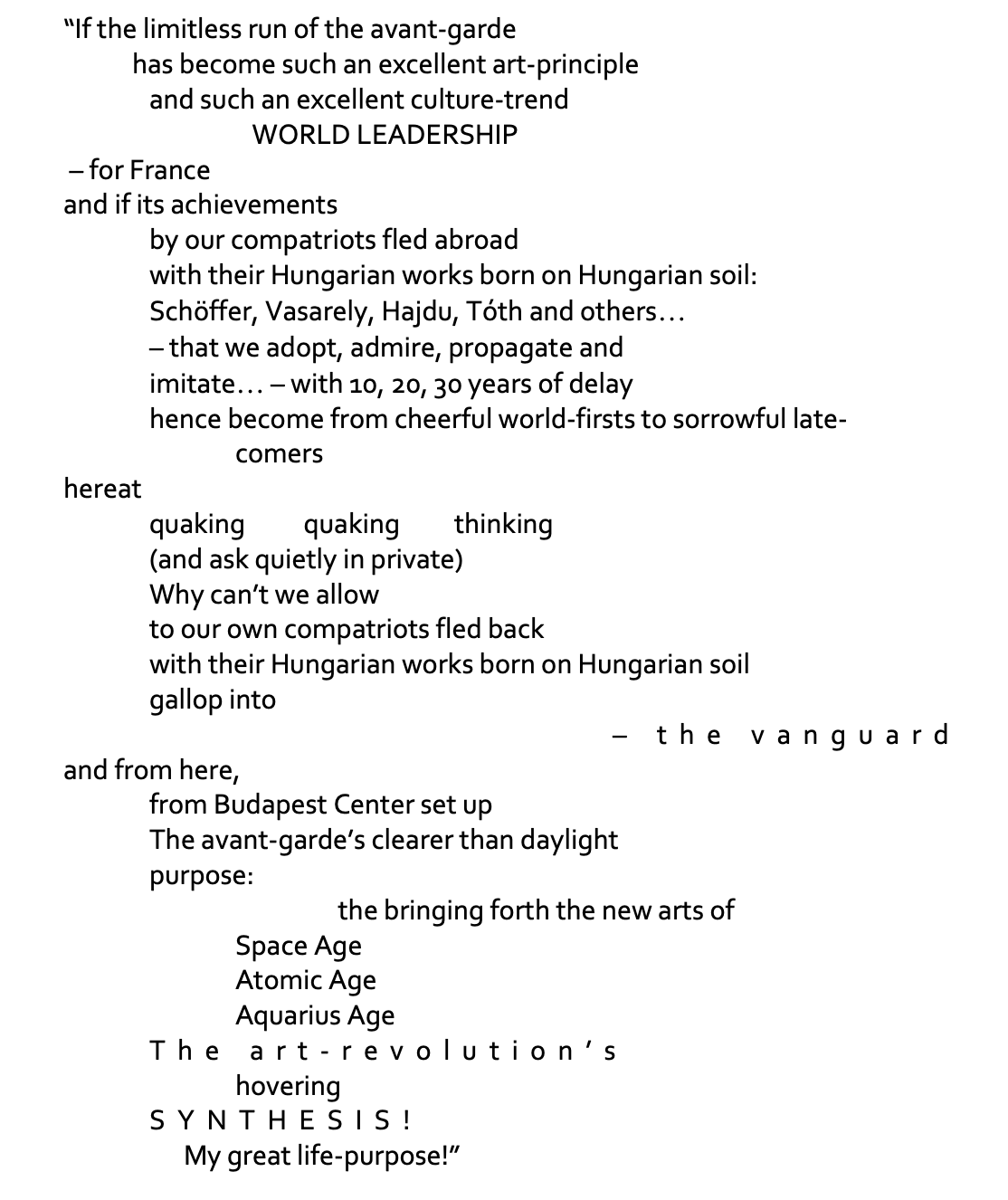
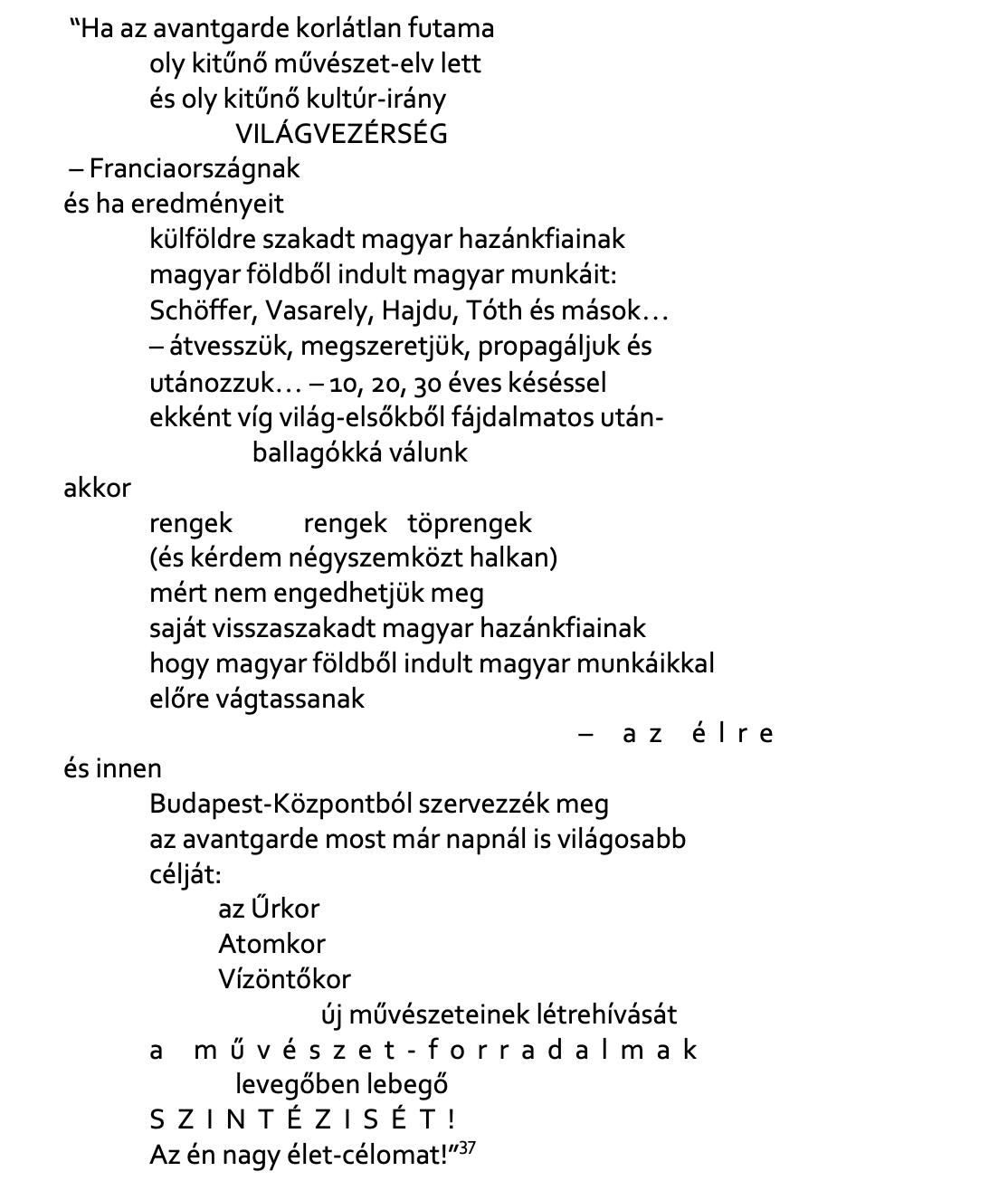
All three poems follow a similar structure: they recall Tamkó Sirató’s early dimensionist career and have the ambition to reconcile it with his late poetry’s futuristic-cosmic manner. For instance, in the poem titled csak egy [Only One], Tamkó Sirató draws an analogy between the significance of dimensionism and Dmitri Mendeleev’s periodic table: “there is only mess / mess / chaos and / tohuvabohu / in the world of avant-garde art / (just as it was among the atomic masses / before Mendeleev’s table) // But my Law of Manifesto / created order / creates order / sets goals / and / explains everything!” [“csak zűr van / zűr / káosz és / tohuvabohu / az avantgárd-művészetek világában / (akárcsak az atomsúlyok közt volt / a Mendelejev táblázat előtt) // De az én Manifesztum-törvényem / rendet teremtett / rendet teremt / célokat tűz ki / és / megmagyaráz mindent!”]36 According to Tamkó Sirató, humanity’s great future, the Space Age, can be realised by recent art occurring along the course assigned by dimensionism; therefore, he created the appearance of continuity between his artistic periods. Of the three poems, rengő töprengő [Quaking Thinking], addressed to Bálint Szombathy, reflects on the conditions of how the historical avant-garde is becoming the tradition of the neo-avantgarde. KÉP 1 KÉP 2
The poem expresses the suspense of how avant-garde artists may encounter the canonisation of avant-garde art by the neo-avant-garde in the 1970s. It clearly discerns two groups. On the one hand, there are the “compatriots who fled abroad”; the world-reknowned Hungarian avant-garde artists who, although once stood at the vanguard of art, their belated “propagation” and “imitation” can render the followers of this tradition mere “latecomers”. This statement alludes to the fact that by the 1970s the achievements of the historical avant-garde no longer represented advancement but had become part of the past, in accordance with Tamkó Sirató’s view. Nevertheless, a second group is introduced: the “compatriots who fled back to Budapest Center”, who could assume a leading role in setting up the new revolutionary avant-garde if given the opportunity. The identity of this figure is not difficult to discern from the poem’s final section: the succeeding art of the Space Age, Atomic Age, and Aquarius Age is defined as his own “great life purpose”.
Tamkó Sirató thus does not designate the exemplary tradition of the avant-garde solely through dimensionism. Instead, he suggests that his late poetry be followed. Although it is apparently derived from dimensionism, it anticipates a utopian cosmic Space Age. Therefore, in contrast to the nominalist treatment of tradition, Tamkó Sirató proposes to the neo-avant-garde artists who seek to align themselves with his oeuvre, a form of contemporary art that surpasses dimensionism, preserving the utopian and anticipatory character of the historical avant-garde. The avant-garde’s relation to history is fundamentally shaped by the desire to come forth and exceed the already existing. In this sense, the notion of following tradition did not primarily mean the adoption of specific poetic practices, but rather a commitment to be timely and current.
Bibliography
Aczél Géza. Tamkó Sirató Károly. Budapest: Akadémiai Kiadó, 1981.
Berg, Hubert van den, “On the Historiographic Distinction between Historical and Neo-Avant-Garde”. In Avant-Garde/Neo-Avant-Garde, edited by Dietrich Schuenemann, 63–74. Amsterdam–New York: Rodopi, 2005.
Bürger, Peter. Theory of the Avant-Garde, translated by Michael Shaw. Minneapolis: Manchester University Press – University of Minnesota Press, 1984.
Cseh-Varga, Katalin. “The plus one dimension”. In Anti-Atlas: Critical Area Studies from the East to the West, edited by Tim Beasley-Murray, Wendy Bracewell and Michał Murawski, 137–145. London: UCL Press, 2025.
Cseh-Varga, Katalin. The Hungarian Avant-Garde and Socialism: The Art of the Second Public Sphere. Bloomsbury Visual Arts, 2023.
Dánél Mónika. Nyelv-karnevál: Magyar neoavantgárd alkotások poétikája. Budapest: Kijárat Kiadó, 2016.
Éva Forgács. “Revolt and Authority: From Kassák to Erdély: Dada in the Hungarian Avan-Garde and Neo-Avant-Garde”. In Cannibalizing the Canon: Dada Techniques in East-Central-Europe, edited by Oliver A. I. Botar, Irina M. Denischenko, Gábor Dobó and Merse Pál Szeredi, 353–371. Leiden–Boston: Brill, 2024.
Foster, Hal. “What’s Neo about the Neo-Avant-Garde?”. October 70 (1994): 5–32.
Kálmán C. György. Élharcok és arcélek: A korai magyar avantgárd költészet és kánon. Budapest: Balassi, 2008.
Kappanyos András. “A magyar avantgárd poétikai spektruma – és két későn érkezett ajánlat”. Híd 83, No. 7. (2019): 74–84.
Kappanyos András. “Másodszorra elvész az első?: A »klasszikus« avantgárd és a neoavantgárd közötti kontinuitás kérdéséhez”. Palócföld 55, No. 3. (2009): 68–74
Krén Katalin and Marx József, eds. A neoavantgarde. Budapest, Gondolat Kiadó, 1981.
Lengyel Imre Zsolt, “Prokruszthész vagy Prométheusz?”. Jelenkor 54, No. 10. (2010): 1099–1103
Nagy Pál. Journal in-time: Él(e)tem 2. Budapest: Phoenix Könyvek, 2002.
Papp Tibor. “Szavak hatásfoka”. Magyar Műhely 35 (1969): 60–64.
- 1: The paper is a reorganised and reconsidered version one of my articles. Fenyő Dániel, “»Ki vágtatott még a holnapba így? – Senki!«: A történeti avantgárd és a neoavantgárd folytonosságának kérdése Kassák Lajos és Tamkó Sirató Károly példáján keresztül”, Helikon 71, 2. sz. (2025): 712–742.
- 2: Krén Katalin and Marx József, eds., A neoavantgarde (Budapest, Gondolat Kiadó, 1981).
- 3: Katalin Cseh-Varga, The Hungarian Avant-Garde and Socialism: The Art of the Second Public Sphere (Bloomsbury Visual Arts, 2023).
- 4: Dánél Mónika, Nyelv-karnevál: Magyar neoavantgárd alkotások poétikája (Budapest: Kijárat Kiadó, 2016), 90–97.
- 5: Kappanyos András, “Másodszorra elvész az első?: A »klasszikus« avantgárd és a neoavantgárd közötti kontinuitás kérdéséhez”, Palócföld 55, No. 3. (2009): 68–74.
- 6: Éva Forgács, “Revolt and Authority: From Kassák to Erdély: Dada in the Hungarian Avan-Garde and Neo-Avant-Garde”, in Cannibalizing the Canon: Dada Techniques in East-Central-Europe, ed. by Oliver A. I. Botar, Irina M. Denischenko, Gábor Dobó and Merse Pál Szeredi, 353–371 (Leiden–Boston: Brill, 2024).
- 7: Peter Bürger, Theory of the Avant-Garde, trans. by Michael Shaw (Minneapolis: Manchester University Press – University of Minnesota Press, 1984).
- 8: Bürger, Theory…, 58.
- 9: “This is to advance three claims: (1) that the institution of art is grasped as such not with the historical avant-garde but with the neo-avant-garde; (2) that the neo-avant-garde at its best adresses this institution with a creative analyis az once specific and deconstructive […]; and (3) that, rather than cancel the historical avant-garde, the neo-avant-garde enacts its project for the first time – a first time that, again, is theoretically endless.” Hal Foster, “What’s Neo about the Neo-Avant-Garde?”, October 70 (1994): 5–32., 20. [emphasis in the original]
- 10: Hubert van den Berg, “On the Historiographic Distinction between Historical and Neo-Avant-Garde”, in Avant-Garde/Neo-Avant-Garde, ed. by Dietrich Schuenemann, 63–74 (Amsterdam–New York: Rodopi, 2005), 68.
- 11: Kappanyos András, “A magyar avantgárd poétikai spektruma – és két későn érkezett ajánlat”, Híd 83, No. 7. (2019): 74–84., 81.
- 12: Tamkó Sirató Károly, A Dimenzionista manifesztum története: A dimenzionizmus (nemeuklideszi művészetek) I. albuma (Budapest: Artpool–Magyar Műhely Kiadó, 2010).
- 13: Károly Tamkó Sirató, “The Dimensionist Manifesto”, trans. by Oliver Botar, Artpool Art Research Centre, accessed: 20.01.2026., https://artpool.hu/TamkoSirato/manifest.html.
- 14: Lengyel Imre Zsolt, “Prokruszthész vagy Prométheusz?”, Jelenkor 54, No. 10. (2010): 1099–1103.
- 15: Károly Tamkó Sirató to Endre Bajomi Lázár, Budapest, 12nd December 1958 – 9th October 1978. Estate of Endre Bajomi Lázár, MNMKK PIM Manuscript Collection, call number: V 3509/3
- 16: Szombathy Bálint, “Kérdések Tamkó Sirató Károlyhoz”, Híd 41, No. 3. (1977): 378–382., 381.
- 17: Tamkó Sirató, A Dimenzionista manifesztum, 106.
- 18: Nagy Pál, Journal in-time: Él(e)tem 2 (Budapest: Phoenix Könyvek, 2002), 200.
- 19: Papp Tibor, “Szavak hatásfoka”, Magyar Műhely 35 (1969): 60–64.
- 20: Károly Tamkó Sirató to the editors of Magyar Műhely, Budapest, [1962–63] – 4th November 1970. Magyar Műhely’s Repository, MNMKK PIM Manuscript Collection, call number: V. 6000/718/1 (around 1962–1963).
- 21: Károly Tamkó Sirató to the editors of Magyar Műhely, Budapest, [1962–63] – 4th November 1970. Magyar Műhely’s Repository, MNMKK PIM Manuscript Collection, call number: V. 6000/718/8 (21st April 1969).
- 22: Károly Tamkó Sirató to the editors of Magyar Műhely…
- 23: Tamkó Sirató Károly, trans., “A francia szürrealista líra csúcsai”, Híd 33, No. 1. (1969), appendix.
- 24: Katalin Cseh-Varga, “The plus one dimension”, in Anti-Atlas: Critical Area Studies from the East to the West, ed. by Tim Beasley-Murray, Wendy Bracewell and Michał Murawski, 137–145 (London: UCL Press, 2025).
- 25: Tóth Gábor, “Dimenzionista album ‘72”, Artpool Art Research Center, accessed 20.01.2026., https://artpool.hu/Poetry/Toth/album1.html#01.
- 26: Szombathy Bálint, Art Tot(h)al: Tóth Gábor munkásságának megközelítése 1968–2003 (Budapest: Ráció Kiadó, 2004), 47–49.
- 27: Ibid., 50–72.
- 28: Szombathy Bálint, “A konkrét költészet útjai I”, Új Symposion 146 (1977): appendix, 9.
- 29: Online: Tamkó Sirató Károly, “Paris”, Artpool Art Research Center, accessed 20.01.2026., https://artpool.hu/TamkoSirato/Paris.html
- 30: Tóth, “Dimenzionista album…”, https://artpool.hu/Poetry/Toth/album1.html#08.
- 31: Tamkó Sirató, A Dimenzionista manifesztum…, 26.
- 32: Petőcz András, “Napjaink vizuális költészeti előfutára: Tamkó Sirató Károly” Tisztatáj 42, No. 4. (1988): 62–77.
- 33: Ibid., 75–76.
- 34: Aczél Géza, Tamkó Sirató Károly (Budapest: Akadémiai Kiadó, 1981), 165.
- 35: Tamkó Sirató Károly, “Poems [csak egy; rengő töprengő; helyzetkép 70–90]”, Új Symposion 15, No. 168. (1979): 132–134.
- 36: Ibid., 132–133.