
Robert Scanlan. Principles of Dramaturgy. New York: Routledge, 2020. 132 p.
Everyone is a dramaturg
Robert Scanlan’s collection of essays, Principles of Dramaturgy,1 was published in 2020 by Routledge in New York as part of their Focus on Dramaturgy series2 . Edited by Magda Romanska, the series, which discusses the theory of dramaturgy from various angles and aims to renew it, publishes writings by numerous experts in the field.3
Scanlan’s book is primarily a practical guide for those involved in dramaturgy, which, according to the author’s definition, includes everyone involved in theatre, from actors to set designers to sound technicians. In fact, he believes that everyone—including the audience—is a dramaturg, since the audience also perceives and shapes the success or failure of a given scene, and a good actor adapts to the changing dramaturgy within a scene. Scanlan therefore interprets the concept of dramaturgy broadly—in his view, dramaturgy is a kind of collective professional sensitivity, not privileged knowledge. The oft-repeated, unanswerable fundamental questions arise for him as well: why is there no precise definition of dramaturgy? What exactly does a dramaturg do? He considers the work of a director to be much more comprehensible to laypeople than that of a dramaturg, even though the boundaries of the director’s role and activities have changed radically, moving away from conventional functions.
Principles of Dramaturgy comprehensively discusses the dramaturgical principles and mechanisms that are essential to theatrical thinking in three major chapters (Form, Action, and Production Dramaturgy).
About the Chapter on “Form” (The Primacy of Form)
The first chapter clarifies how the concept of form can be discussed in relation to different artistic and audience demands. Scanlan repeatedly goes into detail about the misunderstandings surrounding what he calls conventional theatre and theatre that is labelled as postdramatic, abstract, or experimental. For example, we encounter difficulties when the term “postdramatic” becomes synonymous with the opposite of “traditional.” According to Scanlan, this often leads to the misunderstanding that theatre “play” must be performed without rules and that a true artist must reject rules.4 The chapter, which draws on Aristotelian aesthetic traditions and examines the relationship between form and dramatic action, encourages us to examine the dramaturgical structure of the performance. Its basic premise is that all dramatic works can be analysed and interpreted through an analysis of the relationship between content and form, regardless of whether they are classical dramatic or experimental in form. Scanlan attributes all mistakes made in theatre to a lack of elaboration of these two principles and considers their precise knowledge and application to be the basis of creative knowledge, creativity, and spontaneity. The book aims to influence creative practice by illustrating specific methods based on exploring the interaction between form and plot.
According to Scanlan, a theatrical work of art is more visible if the story itself is missing or pushed into the background, as abstract formal language often reveals the essence more openly and clearly. At the same time, there is the paradoxical experience that the more reduced and abstract the form of a theatrical performance, the more difficult it is for the average audience to access it. American (and average European) audiences are most disturbed by cases where artistic expression takes precedence over the content that is intended to be conveyed directly. Scanlan uses this to explain the gap between public taste and experimental, extreme behaviour.
In the realistic, representational style, the formal elements of the plot are just as present and just as artificial as, say, in a Robert Wilson composition, but they are more difficult to distinguish in the blurred perception of “realism”, which, according to Scanlan, is the audience’s point of view, not that of the theatre artist. Throughout the chapter on form, the artistic (more open to abstract language) conception is contrasted with the “average” viewer’s perspective. “American audiences are most baffled on those occasions of greatest artistic clarity, and this explains the rift that occurs between popular taste and an esoteric craving, among artists, for the ‘pure’ experience of formal construction and experimentation. We can gauge how deep-seated the popular American appetite for ‘life-likeness’ is when we notice that it is formal transparency that baffles the comprehension of the average theatergoer.”5 Scanlan thus writes about the clash between American audiences, who are less receptive to formal complexities, and artistic desires for experimentation and wild formal adventures. Scanlan’s assertion presupposes a more unified artistic perspective. From an Eastern European theatre perspective, this may seem incomprehensible, simplistic, and crude, since from the inside this dichotomy is obviously inapplicable to a professional milieu that is at once diverse and polarised, yet also quite homogeneous. There can be no question of unity and aesthetic points of reference. Creators often do not understand each other at all; their attitudes are quite heterogeneous and incoherent. Taste has become an irrevocably diffuse and elusive category. Hungarian audiences who go to art theatres are hungry for more experimental, more exciting performances, but artists are unable to break out of their own frameworks and produce a series of self-contained, repetitive performances.
Scanlan uses Lessing’s treatise Laocoon6 to conceptualise the functioning and operation of stage forms. According to Lessing, the first principle of constructing a fictional world is that “signs that follow one another [in time] can express only objects whose wholes or parts are consecutive”; furthermore, “objects or parts of objects which follow one another are called actions.”7 Thus, poetry—the art of “articulated sounds in time”—necessarily deals with actions. On stage, although bodies are present as images, they also exist in time, and at every moment of their existence they can take on a different appearance or be in a different combination. Each of these momentary appearances and combinations is the result of the previous one and can be the cause of the next, which means that it can be the focus of an action.8
When studying form, Scanlan believes that a balance must be struck between the attraction to realism and artistic demands. He believes that the first task of a person engaged in serious artistic work should be to understand form, and only then should they move on to analysing the unavoidable basics—the theme, the story, the characters, the setting, the historical context, and the style of speech. To facilitate a deeper exploration of form, Scanlan has created a system of diagrams that he believes is suitable for studying all dramatic texts, regardless of the genre and style of the play.
The Plot-Bead Diagram
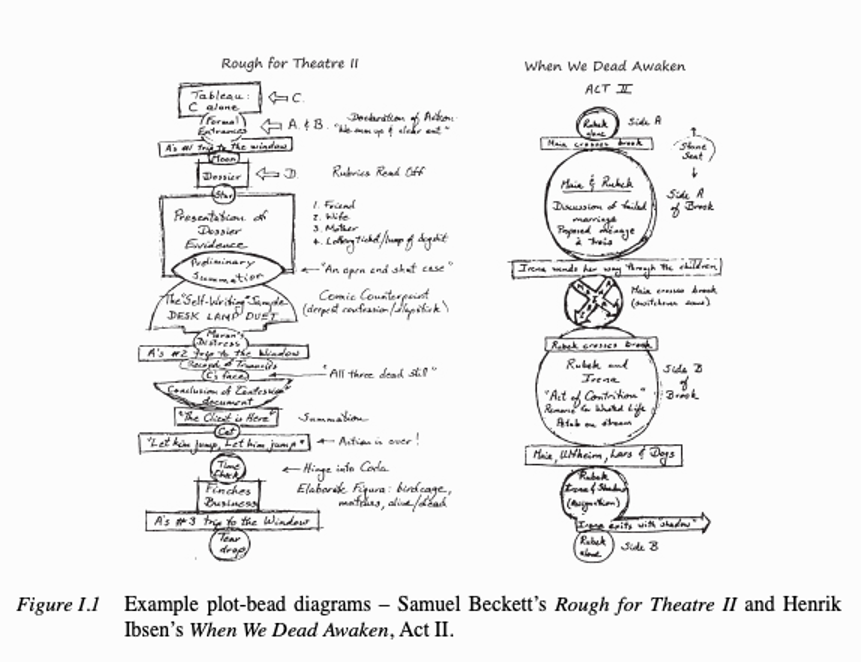
Scanlan analyses dramatic texts using his own plot-bead technique. This diagram, like a musical score, visually represents the development of the basic coordinates of the performance, simultaneously marking and showing changes in space and time. The plot-bead is primarily intended to represent the arc of the plot, which, according to Scanlan, is usually difficult to see clearly even for experienced professionals. The plot-bead diagram thus aims to provide an easily comprehensible framework for all participants in the performance, serving as a common basis, starting point, and analytical tool for the director, dramaturg, or even the entire creative team.
(The term “plot-bead” is a neologism coined by Scanlan, referring to the fact that the plot of a play can be visualised as a pattern similar to that of a string of pearls.) KÉP 1
The diagram clearly indicates the beginning, turning points, and end of the performance. To construct a plot-bead diagram, it is necessary to rethink where the boundaries and subunits of the scenes lie. (Scanlan emphasises that the drama must necessarily begin at a definable point in time, then inevitably continue, and end at a moment that is as concrete and recognisable as the previous ones). The plot-bead diagram depicts the play as a “string of events,” with the timeline as the “thread” holding the string together and the beads as the units of time, or “events,” whose sequence forms the formal composition of the play.
The question arises as to what can be called a unit of time to be marked, since dramatic material does not have a system that can be clearly divided according to a uniform system. Or, if it does, what criteria do we use to divide the texts, and where do we place the dramaturgical emphases? A significant part of the joy and freedom of creation comes from free, instinctive intuition and associative decisions, which is why most creators develop their unique formal solutions spontaneously, based on their own research and insights, sometimes only during the rehearsal process.
Doesn’t Scanlan’s beading seem anti-creative, a rigorous systematisation? The bead string can be a mould for experimentation, open to creators who are searching for free forms. What real benefits can it bring to practicing theatre-makers? And, in general, how should practising dramaturgs, directors, and actors approach reading the book? Reading specialised texts is a rare phenomenon, at least among Hungarian theatre creators. Few young theatre professionals can name a specialist book that has influenced or shaped their thinking about theatre, and few even consider reading specialist texts.
An interesting topic that could be added to the book is what advice Scanlan, outraged by collective professional incompetence, would give to young artists of the 21st century in his book, and in general, for reading professional texts. In terms of theatre, writing and written texts have a past tense. Scanlan expresses his anger and disappointment (sometimes as if he were already annoyed in advance, asserting that provocation alone does not create a new form), which stems from the many experiences of sloppiness and inaccuracy he has encountered during his career. He intends his study to be a cry, a call for action, but he does not discuss the difficult aspects of how to combine this kind of awareness—the organising awareness of the plot-bead diagram—with spontaneous, free, creative experimentation.
In any case, one of the most fruitful effects of Scanlan’s technique could be that creators read the plays several times in succession and with genuine attention. What is still worth considering and exploring in Scanlan’s method, and—especially from a Hungarian perspective—prompts an interesting assessment, is the communal nature of theatre-making. In Hungary, there is a well-established tradition, even a cult, of the aforementioned non-understanding, non-interpretation, lack of reflection, and the behaviour of directors and dramaturgs that forces actors into a position where they only have to worry about their own tasks and work out their own parts as best they can. This harmful attitude leads, not least, to the fact that many actors do not even feel the desire to think about the moral, political, and human messages conveyed by the performance they appear in. A disturbing number of actors do not care about the context in which the performance is created or the deeper levels of meaning at which it can be interpreted. The responsibility is mutual: the profession (directors) does not always expect this, does not always reward it, and indeed, the legitimisation of this attitude is based on historical traditions. In many cases, it is not true that actors do not care about their circumstances, but rather that they are powerless in their vulnerable position, playing for low pay, and do not know what to do. The undoubted advantage of Scanlan’s plot-bead technique is that it fosters a community spirit and high standards, as its aim is to ensure that actors also understand the formal driving forces behind the performance, rather than this knowledge being the sole privilege of the director.
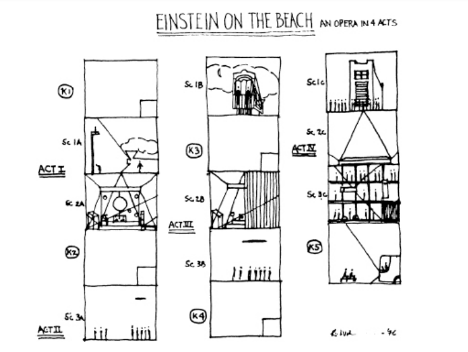
Principles of Dramaturgy presents five dramaturgical case studies: an excerpt from Shakespeare’s Julius Caesar (Act IV, scenes 2-3), Robert Wilson’s script outline for Einstein on the Beach, Samuel Beckett’s Rough for Theatre II, Eugène Ionesco’s The Bald Soprano, and Gotthold Lessing’s Minna von Barnhelm (Act I). With these diverse examples, Scanlan demonstrates the applicability of the plot-bead diagram to performances of the most varied styles and forms, proving that there is no dramatic material, regardless of the era or style in which it was created, for which a plot-bead diagram cannot be constructed. Of course, this does not mean that the depicted plot lines cannot differ significantly from each other in terms of their formal coherence and the content inherent in their form.
Scanlan pays particular attention to Robert Wilson, whom he frequently refers to in the text. Wilson himself always works with plot diagrams he developed himself (perhaps this also played a role in Scanlan’s plot-bead fantasy, which is another argument against the impracticality of the method), sketching out all his ideas, much like a graphomaniac feels compelled to constantly write things down. Wilson’s characteristic drawings set up comic-like storyboard frames in which he visually illustrates the plot. KÉP 2
His images are proscenium-framed viewpoints of the dominant geometry of each scene, so their primary abbreviations are spatial rather than temporal in nature. Wilson arranges the spatial viewpoints in chronological order, the form and direction of which correspond to the plot-bead diagram; similarly to the diagram, the figure presents the form of the entire performance from a single viewpoint. Wilson’s scene-framed storyboards summarise the entirety of the dramatic composition. Scanlan looks up to the formalist theatre director as a role model, who works in clear and transparent forms despite a stage language based on a different kind of sensuality, generally eschewing linearity and narrativity, and whose managers, assistants, and dramaturgs work separately on the formal documentation of each production.
Fixations and Feelings of Lack
Although Scanlan emphasises that his plot-beads apply to a wide variety of radically different plays, his choices could be much bolder. It would have been interesting, for example, to bring out avant-garde works that have been pushed to the periphery, whose plot-bead diagram analysis could lead to surprising insights. In the absence of extreme examples, Scanlan’s basic premise carries less weight, and the revelatory power of his arguments, at least for me, is lacking. Although Beckett’s dramaturgy and stylised language take a bolder direction, Scanlan does not use truly performative or contemporary examples but sticks to the world-famous Wilson and the well-established classics (Ibsen, Shakespeare). It may be that he had no intention of illustrating his analytical structure with post-dramatic works, which he considers problematic anyway, but it would have been more authentic and exciting to illustrate his analytical structure through works in which linear-narrative understanding is less obvious and clear, and whose formal exploration is therefore more challenging. This would have allowed the book to appeal to a wider audience.9
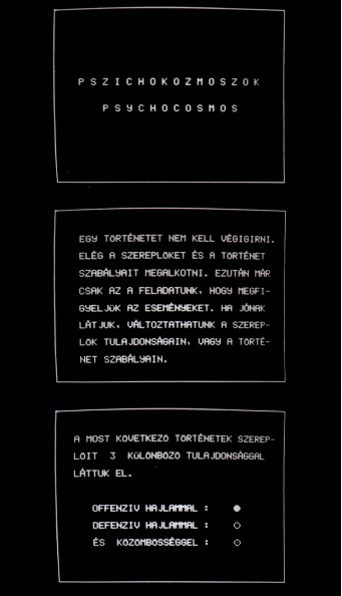
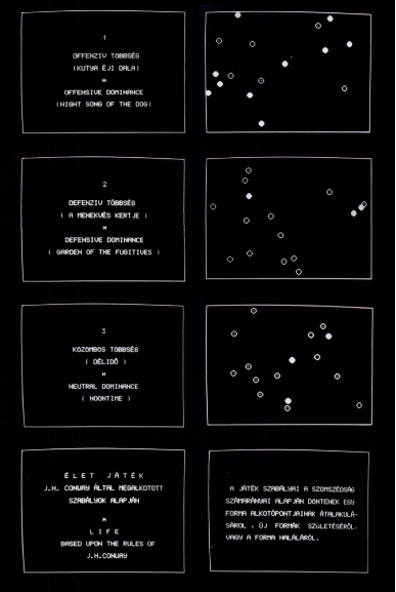
Scanlan’s method brings to mind the equally radical image-associating computer experiment illustrated by Gábor Bódy’s10 diagram technique, which places dramaturgical structure in a completely different perspective. KÉP 3 KÉP 4
Bódy, who developed his system in collaboration with a nuclear physicist, does not view it primarily from the perspective of rational understanding, and he has also shown himself to be open to the idea that the diagram of his own creation could take on a life of its own:
“The program was calculated by theoretical nuclear physicist Sándor Szalay. When I asked him why, in all three cases, some of the balls stick together after colliding, then separate after a while, he replied that he hadn’t expected this either and had no idea why.”11
Scanlan does not get bogged down in theoretical debates, but offers straightforward, practical, usable principles and methods. He consciously positions himself both within and in opposition to contemporary critical discourse, acting as a kind of counterpoint; because of this dual position, Scanlan’s scepticism and blunt phrasing should be treated with caution. The book engages in dialogue with 20th- and 21st-century critical theories (e.g., poststructuralism, deconstruction, postdramatic theory, performance studies), but does not join them, instead taking on a corrective, balancing role. Scanlan’s monomania (this term has been the subject of passionate research in Hungarian theatre tradition since the end of the 20th century) sometimes leads to oversimplification. His thinking is often dogmatic and lacks any mention of creative methods and systems of association other than his own, thus appearing conservative in many respects within the horizon of contemporary theoretical discourse. He also states relatively uniformly in the book, without context, that the plot is inevitably the origin of theatrical activity, mentioning more abstract and postdramatic forms. However, plot development is not always and in all cases the driving force and main attraction of a theatrical work.12
He draws a parallel between dramatic construction and architecture.
“If one were building furniture (chairs and tables, for instance), a useful principle would be an appreciation of gravity, and its inevitable role in the craftsman’s art. The concepts of ‘level’ and ‘vertical’ or ‘square’ are direct expressions of the single inescapable principle of gravity, and very specific tools – carpenter’s levels and carpenter’s squares – are basic tools that govern carpentry. Architecture has an identical foundational relation to gravity, and with it to strength of materials and principles of load bearing, and stability of structures. No one can practice either carpentry or architecture without a close compliance with principles of this kind (in this case, all founded on gravity).”13
However, theatre arts are not carpentry. The theatre person is allowed to cheat and lie. Associative, spontaneous, ill-considered decisions are relevant in theatre. While it is appropriate for an architect to be familiar with the laws of gravity, it is not necessarily to the advantage of theatre arts if every step is calculated and explainable.
Nevertheless, Scanlan defends theatre as a structured, time-unfolding action against purely conceptual or theoretical approaches, always on the condition that we see not only the elements of the “story,” but also form and action as the cornerstones of dramaturgical work. His approach is classically conservative in the sense that he bases the craft of theatre on timeless principles of form and action, and sees creative freedom not in questioning or rejecting rules, but in consciously applying them. This position is more restrained than postdramatic, performative, or theory-centred contemporary theatre but it places creative work on a more stable and predictable foundation. Scanlan himself reflects on the conservative implications of the dramaturg’s work: “The conservative implications of curatorial dramaturgy operate side by side with a countervailing obligation to renew the art form.”14 In other words, one of the dramaturg’s tasks is “faithful cultural transmission,” that is, preserving traditions and respecting the original intentions of the author. However, this must be balanced with innovation. This perspective does not reject innovation but interprets the task of the present from the perspective of the past, which is a classic conservative dramaturgical position.
Despite its shortcomings and questionable features, Principles of Dramaturgy is a thought-provoking work that does not limit dramaturgy to the boundaries of the profession but elevates it to the common language of theatre as a whole. Another topic for discussion could be the advantages and disadvantages of viewing dramaturgy in this way. Its pragmatic clarity can be useful for theatrical practice, as it offers both theoretical clarity and practical tools, while emphasising that dramaturgy is the shared, constantly evolving, and articulating knowledge of the theatrical community. This approach can be inspiring for all those who interpret theatre as a totally communal creation from the first step to the last. It is worth considering how Scanlan’s principles and approach can fit into, or even be excluded from, our own theatrical work. Principles of Dramaturgy is a good companion for theatre thinkers and creators, whether as a guide or as a counterexample.
- 1: Robert Scanlan, Principles of Dramaturgy (New York: Routledge, 2020).
- 2: Magda Romanska, ed., Focus on Dramaturgy series (New York: Routledge.) The book was published in collaboration with TheTheatreTimes.com.
- 3: Information about all the pieces in the series: https://www.routledge.com/Focus-on-Dramaturgy/book-series/RFOD.
- 4: Robert Scanlan, Principles of Dramaturgy, The shibboleth of “Realism,” and the postulation of the “postdramatic”.
- 5: Robert Scanlan, Principles of Dramaturgy, The basic principles: Form: time and the plot-bead diagram.
- 6: Gotthold Ephraim Lessing, Laocoon: An Essay on the Limits of Painting and Poetry, transl. by Edward Allen McCormick (Dover Publications, 1984) in Robert Scanlan, Principles of Dramaturgy, Form: Form in the theatre.
- 7: Lessing, Laocoon…
- 8: Robert Scanlan, Principles of Dramaturgy, Form: Form in the theatre.
- 9: Shifting these boundaries and taking a leap into the deep end could be achieved, for example, through Joseph Nadj’s performances, which are based on strong visuality and physicality, or through one of Artaud’s abstract Mexican theatrical fantasies, such as Séraphin’s theatre, which is not even a sketch of a performance, but an offer of radical sensual liberation of the body, an imaginary plot-bead diagram, or András Jeles’s plot-bead diagram analysis of one of his plays. (András Jeles [1945–) is a Hungarian film and theatre director and writer. His works defy predictability and are characterised by unexpected leaps of thought and a unique, catastrophic, and extremely ironic language.)
- 10: Gábor Bódy (1946–1985) was a Hungarian film and theatre director and thinker. His work and creative personality combined technical expertise, a thorough knowledge of materials (celluloid, videotape) and tools (cameras and optics), theoretical knowledge, and the power of imagination.
- 11: Bódy Gábor, Egybegyűjtött filmművészeti írások 3. Pszichokozmoszok (Budapest, MMA Kiadó, 2021). (My translation – S.S-T.)
- 12: It can just as easily be a sound, colour, repetitive words, etc. An example of this is Beckett’s monodrama Not I#, in which only a moving mouth is visible (the rest of the face is shrouded in darkness), dynamically propelling the speech. Scanlan writes simplistically about the tension between postdramatic and conventional theatre. “A difficulty arises if ‘postdramatic’ has acquired the burden of meaning the polar opposite of ‘conventional.’ It then misleads by suggesting that the ‘game’ of theatre is now under an obligation to be played without rules. Every artist is supposed to hate rules, and ‘principles’ sounds like ‘rules.’”
- 13: Robert Scanlan, Principles of Dramaturgy, The shibboleth of “Realism,” and the postulation of the “postdramatic”.
- 14: Robert Scanlan, Principles of Dramaturgy, Making difference.